Tracking Post Election Processes Across 50 States
July 7, 2026
The period following Election Day requires precise administration and adherence to statutory deadlines. It can be difficult for judges to comprehend post-election deadlines as they contend with often high-profile post-election litigation. The Election Law Program published a comprehensive tool that details nearly 200 post-election deadlines in all fifty states.
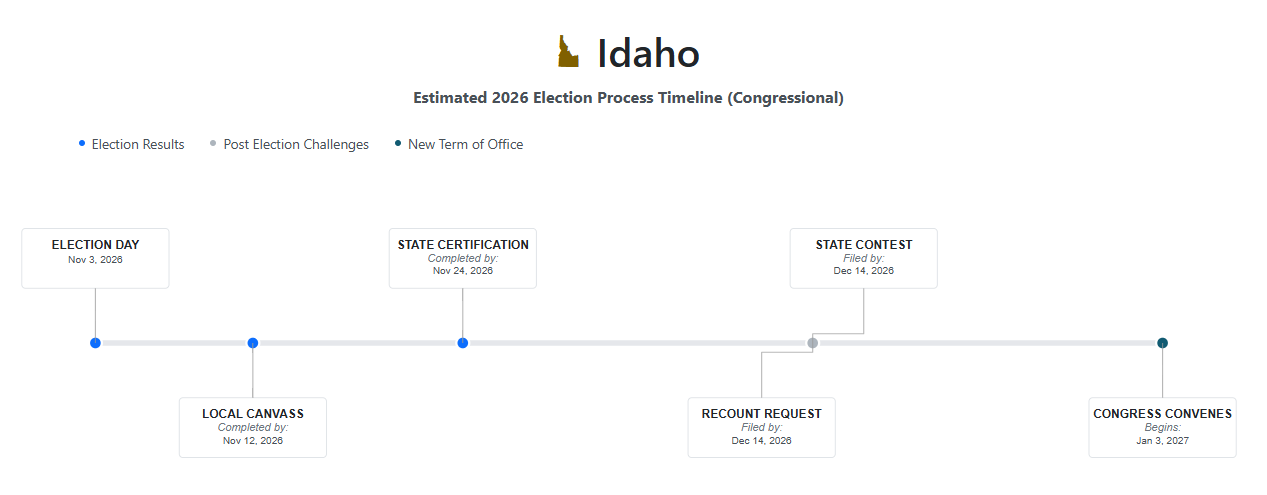
Above is a sample timeline from Idaho.
This resource is available at electionlawnavigator.org/timeline/postelection/2026. It provides clear timelines for local canvasses, state certifications, recount requests, and state contests. We structured the report to guide users through three distinct phases. These include Election Results, Post Election Challenges, and the New Term of Office.
States generally follow a three step process to finalize election results. First, they consolidate precinct-level returns on election night. Local officials then canvass those returns. Finally, state officials certify the election. The timelines for these processes range from a few days to over a month. Most jurisdictions finish their local canvass within two weeks and complete their state certification within 28 days of the election. Several states deviate from this standard window. Oklahoma operates on a compressed timeline and certifies its elections just ten days after Election Day. Arkansas stretches its process significantly and delays certification until December 18. The strictness of these deadlines also varies. Vermont mandates that officials send their returns to the state within 48 hours after the close of polls. Rhode Island takes a flexible approach and requires the state certification to be completed with all reasonable expedition.
Most states permit a recount before certified winners take office. Though states like Mississippi do not permit recounts. The rules governing recounts vary dramatically across jurisdictions. Some states trigger recounts automatically when margins are exceptionally tight. Others require a candidate to formally request and fund the second tally. The timing also differs. Most jurisdictions delay recount processes until after state certification. A few outliers permit recounts immediately following the local canvass. The threshold for permissive recounts adds another layer of complexity. Statutes generally require the margin of victory to fall below a specific percentage or raw vote count. Alabama calculates this margin as a percentage of the total votes cast for the office rather than the raw vote difference between the top candidates. Restrictions on who can request a recount also vary. While most laws restrict this right to candidates, some states, such as Alaska, take a broader approach by allowing groups of voters or political parties to initiate the process.
Most states permit a contest before certified winners take office. (Contests, as opposed to recounts, challenge some aspect of how the election was administered.) The criteria and rules governing these proceedings vary widely. Ten states do not permit contests for congressional elections and defer to Congress’s authority. Kansas explicitly bars contests by stating its election contest provisions do not apply to the election of a United States senator or representative in Congress. For states that do permit contests, the filing deadlines differ. Most require prompt action, but Missouri serves as a notable outlier by allowing a contest to be filed up to one year after the election. The individuals authorized to initiate a contest also differ by jurisdiction. Standard practice restricts this to the aggrieved candidate. Hawaii broadens this scope to include either a candidate or a group of thirty voters. New York expands standing further by permitting the chairman of any party committee to file a contest. The underlying reasons for filing contests generally include candidate eligibility, illegal voting, errors by election officials, or fraud in the process.
We compiled the statutory citations and calculation rules for each state to provide clarity for election administrators, legal professionals, and the public.
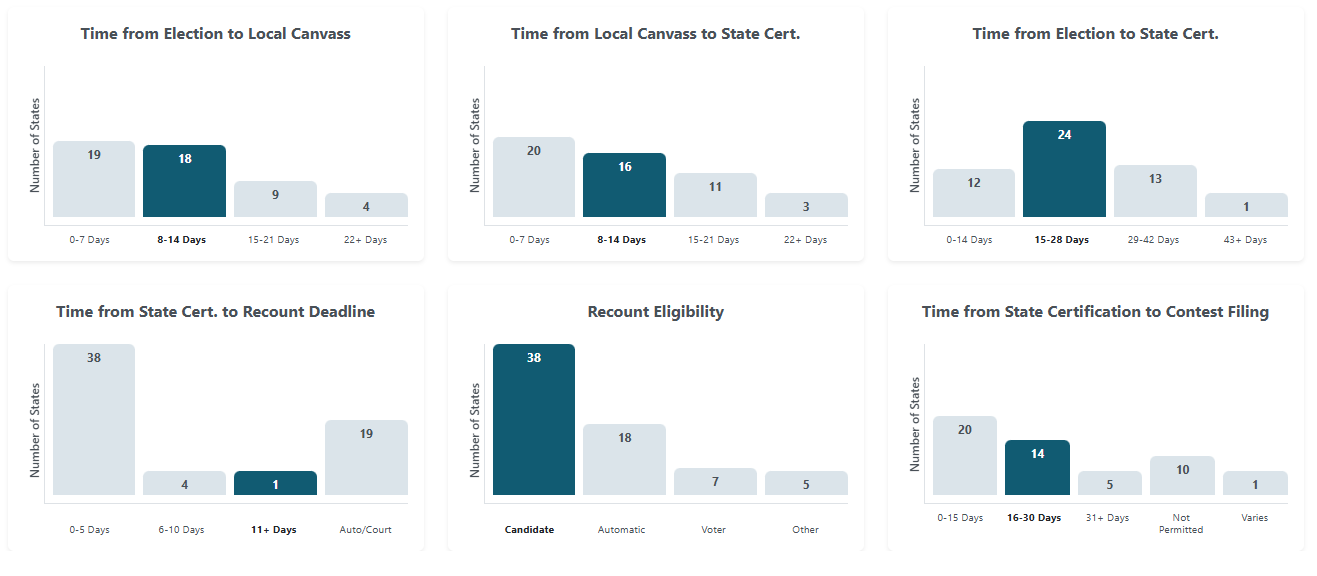
The above charts show some of the differences in these processes across the country.
State laws governing post election periods are complex and vary widely. Statutes dictate whether an action must commence or finish by a specific date. The ELP calculated the calendar date for each action for the November 2026 general and noted whether the date represents the beginning of a window or the final deadline for completion. Some jurisdictions allow discretion regarding the exact timing of an event. Estimated dates are adjusted where known local practice impacts these schedules, as seen in Massachusetts. Many states also maintain specific statutory rules for calculating time that exclude weekends or holidays. These computation rules are applied to ensure accuracy.
State election directors reviewed draft reports prior to publication to ensure accuracy. If you see an error or state law has changed, corrections may be submitted directly through the tool at the foot of each state page as directed. The ELP would be grateful for feedback to improve the tool.