Rethinking Vote Dilution Remedies: Ranked Choice Voting in Newburgh
April 15, 2026
On its face, the Town of Newburgh’s decision to adopt ranked choice voting (RCV) sounds like a technical tweak to ballot design. In reality, it marks a moment in which the New York Voting Rights Act (NYVRA) begins reshaping how local governments structure elections.
On March 2, 2026, a New York state judge approved a settlement requiring Newburgh to overhaul how it elects its five-member town board, including the town supervisor. Beginning next year, the town will abandon its at-large election system and implement ranked choice voting, including a proportional form for its multi-seat town board elections. The settlement resolves a 2024 lawsuit alleging that the town’s at-large system diluted the voting power of Black and Hispanic voters in violation of the NYVRA. The town did not admit liability, but it agreed to change its election structure and pay $1.6 million in attorney’s fees.
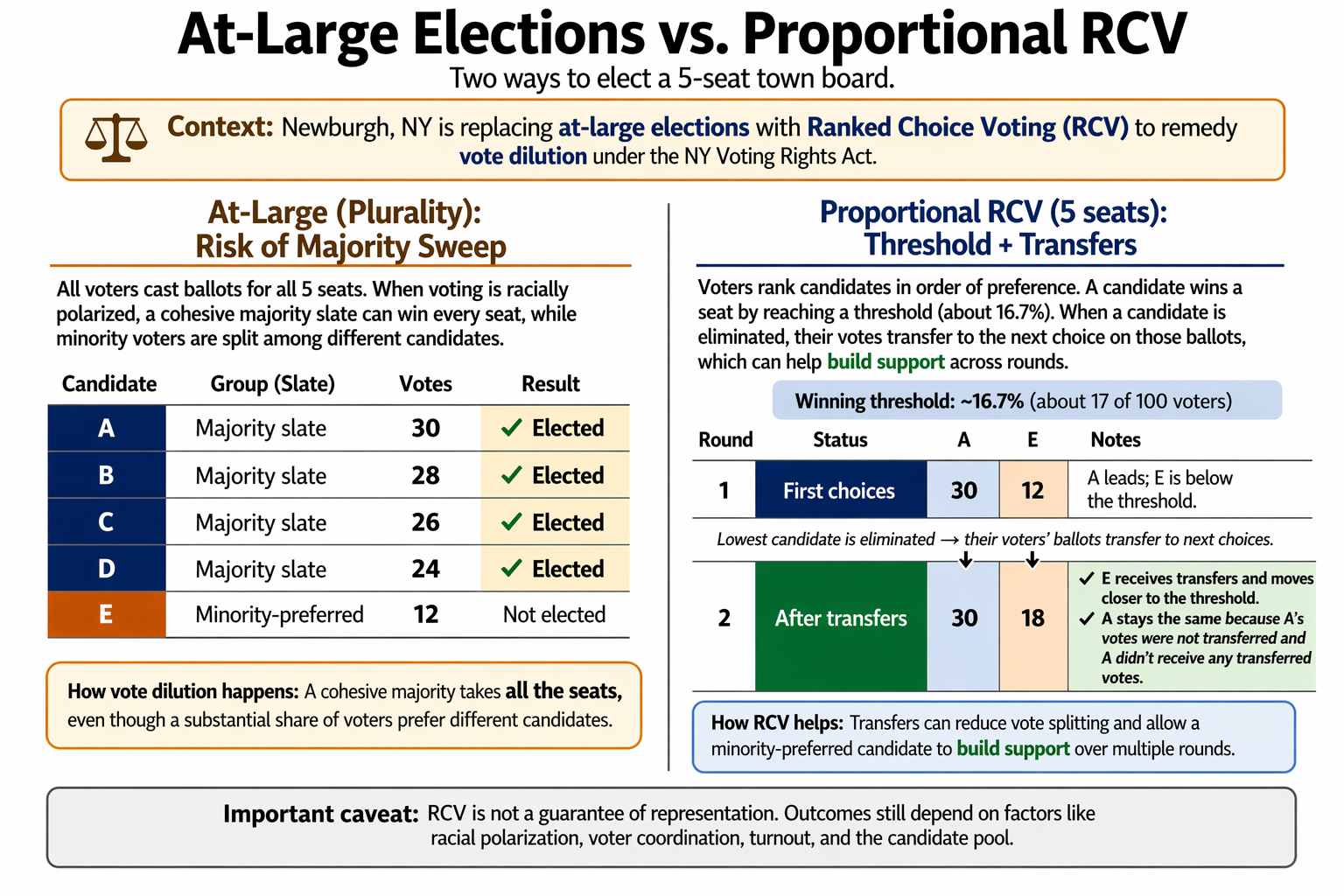
Newburgh’s prior system concentrated power in a single town-wide electorate. Under the at-large system, all voters cast ballots for all five board seats. If multiple seats were on the ballot, each voter could select as many candidates as there were seats available, and the candidates with the highest vote totals won. However, when voting is racially polarized, that structure can allow a cohesive majority to sweep every seat, even if minority voters make up a substantial share of the population. This is known as vote dilution: minority voters are not denied the ballot, but the structure of the election weakens their ability to translate votes into representation.
Under federal law, proving vote dilution can be difficult. Plaintiffs must show, among other things, that the minority community is sufficiently large and geographically compact enough to form a majority in a district, that minority voters tend to support the same candidates, and that voting is racially polarized in ways that usually allow a majority bloc to defeat the minority community’s preferred candidates, under Thornburg v. Gingles. The NYVRA, enacted in 2022, lowers some of those barriers under state law. If plaintiffs prevail, municipalities must pay the plaintiffs’ attorney’s fees, which significantly increases the financial risk of litigation.
The most notable feature of the Newburgh settlement is not that the town agreed to change its system, but how it chose to do so. In most vote dilution cases involving at-large elections, the conventional remedy is to replace the at-large structure with single-member districts. That means dividing the municipality into separate geographic districts, each electing one representative rather than having all voters select all seats. If a minority community is geographically concentrated, drawing a district that reflects that concentration can give that community a realistic opportunity to elect a candidate it prefers. This district-based model has long been the default corrective tool in voting rights litigation, which makes Newburgh’s decision to pursue a different path particularly significant.
In theory, ranked choice voting can mitigate one of the central problems in at-large elections: vote splitting. When multiple candidates appeal to the same voter base, their supporters may divide their votes among them, allowing a unified majority slate to win every seat. Ranked choice voting changes that dynamic by allowing voters to rank candidates in order of preference. When the lowest-performing candidate is eliminated, those voters’ ballots count toward their next-ranked candidate. As a result, support that might otherwise fragment across several candidates can accumulate across counting rounds.
In Newburgh’s case, the system will operate as proportional ranked choice voting for town board seats. Rather than simply selecting the top vote-getters in a single tally, candidates win a seat once they reach a defined vote threshold.
At the same time, RCV is not a guarantee of representation. It does not create a district in which a minority community forms a numerical majority or has built-in electoral control; it alters how votes are counted, not how voters are grouped into districts. If majority voters continue to vote cohesively and coordinate effectively, they may still dominate outcomes. Whether RCV meaningfully mitigates vote dilution will ultimately depend on local political dynamics: patterns of racial polarization, turnout levels, and the number and profile of candidates.
Newburgh will become only the second municipality in New York, after New York City, to use ranked choice voting in its elections. Once a major jurisdiction implements a reform, it becomes easier for smaller towns to follow. The administrative systems already exist, election officials have a model to replicate, and the political optics shift from untested to established. If municipalities facing NYVRA lawsuits begin to see RCV as a ready-made settlement template, what happened in Newburgh could quickly become a pattern rather than an exception.
The Supreme Court has grown increasingly skeptical of race-based line drawing in redistricting. Race-conscious district design can trigger strict scrutiny and prolonged litigation. Ranked choice voting avoids the need for race-conscious district lines that often trigger strict scrutiny. For municipalities concerned about both compliance and constitutional risk, that distinction may make RCV a more attractive remedy than traditional district-based restructuring.
The key question going forward is whether this procedural shift delivers substantive change. Does ranked choice voting increase the ability of minority communities to elect candidates they prefer? Or does it simply adjust ballot design while leaving underlying power dynamics intact?
Newburgh’s settlement does not resolve that debate. What it does show is that the New York Voting Rights Act is already influencing the structure of local governance. Instead of redrawing district lines, at least some municipalities may respond to voting rights litigation by redesigning how ballots are counted. If other municipalities follow the same path, the most consequential changes in New York election law may come from negotiated redesigns of how votes are counted.